How to Teach Number Bonds to 10: Five Playful Activities
Number bonds to 10 are pairs of whole numbers that add up to ten, such as 6 + 4 and 7 + 3. To introduce them, make ten visible, split it into two parts and put it back together. A child can then see what the number sentence describes.

Show the whole before asking for a missing part
Draw two rows of five boxes to make a ten-frame. Fill every box, count the ten objects together, then separate them into two groups. Say what you see: “Ten altogether. Six are here and four are there.”
This is part–whole thinking: the same whole can be made from different smaller parts. NCETM’s composition guidance describes the connection between a whole number and its parts. These activities turn that idea into specific rounds to play at home.
The number bonds to 10
Reverse pairs also work: 9 + 1 = 10, for example. Swapping the parts does not change their total. Include zero too: ten in one group and none in another still makes ten.
| First part | Second part | Number sentence |
|---|---|---|
| 0 | 10 | 0 + 10 = 10 |
| 1 | 9 | 1 + 9 = 10 |
| 2 | 8 | 2 + 8 = 10 |
| 3 | 7 | 3 + 7 = 10 |
| 4 | 6 | 4 + 6 = 10 |
| 5 | 5 | 5 + 5 = 10 |
Five ways to practise the same idea
1. Fill the empty spaces
Put six counters in a ten-frame, filling one row before the next. Ask how many spaces remain. Your child can place a differently coloured counter in every empty box, then describe both groups. Repeat with a new starting quantity while keeping all ten spaces visible.
Ask together: “Six are filled. How many more will fill the frame?”
A little adjustment: Explore totals of five using a five-frame if ten feels too much to track.
2. Change one thing
Arrange three counters in one group and seven in another. Move one counter from the second group into the first. Compare 3 + 7 with 4 + 6. The first part grew by one while the other shrank by one. Put the counters back to check that the whole is still ten.
Ask together: “What changed? What stayed the same?”
3. The missing postcard
Draw ten circles. Cover four with a blank card, leaving six visible. Tell your child there are still ten altogether. Invite them to say or draw what the card is hiding, then uncover it to check. Let them set the next puzzle for you.
Ask together: “Ten altogether, six showing. How many are hidden?”
A little adjustment: Let the child check the complete picture before covering a part.
4. Find a partner
Write 0 to 10 on eleven cards. Choose one, such as 8, then find the card that partners it to make ten. Build that pair on the frame before choosing another. Make a second 5 card if you want to represent 5 + 5 with number cards.
Ask together: “Which partner does eight need? How can we check?”
5. Tell the whole story
Build ten with seven counters on one side and three on the other. Say 7 + 3 = 10, then swap the groups to show 3 + 7 = 10. Remove the three to show 10 − 3 = 7. Put them back, then remove seven to show 10 − 7 = 3.
Ask together: “Which part is missing from the whole now?”
A little adjustment: Introduce one number sentence at a time if four at once feels confusing.
When a child counts from the beginning every time
Counting is still a way to check an answer. Leave the frame visible and ask about its structure: “The top row has five. How many are on the bottom?” Try the same pair in another round before changing every part of the activity.
If a child remembers that four pairs with six, ask them to show that four on the frame. This gives you a conversation about the explanation alongside the remembered answer. If the whole changes accidentally while moving counters, fill all ten spaces together again.
When to try totals other than ten
When your child can show and explain several pairs, choose a different total together. For example, 7 + 8 = 15 and 13 + 7 = 20. Draw enough spaces for the new whole instead of assuming the ten-frame still represents it.
There is no fixed number of days or perfect answers before moving on. Notice whether your child can explain the two parts, find a missing part and check the total in different arrangements.
A little more to discover.
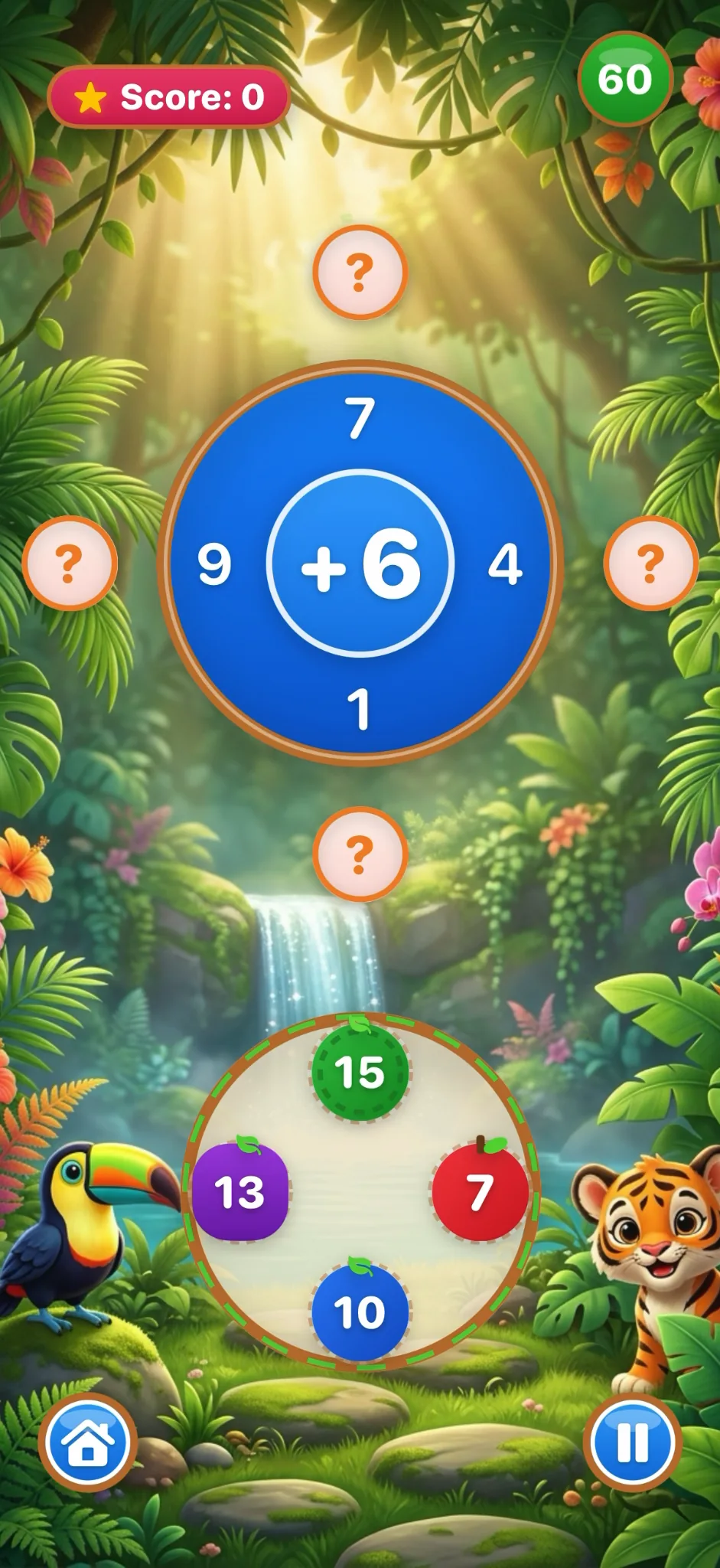
Try the free three-question web taster on our number-bonds guide before downloading. In the app, Make 10 Pop is in the Family Subscription. Pop 10: Bubble Blaster is a separate bonus game and also needs its earned core-game milestone. Subscribing alone does not open every bonus stage.
Explore the game guideMade for iPhone & iPad, iOS/iPadOS 16+.
Free download with three core games to start. See current prices and subscription details in your local App Store.
Sources & further reading
These resources provide educational background and further activities. The worked examples and illustrations in this guide were created for the Kids Maths Games parent blog.
- NCETM: Composition
Background on a whole number and its smaller parts.


