How to Teach Halves and Quarters with Simple Sharing Games
A half is one of two equal parts of a whole. A quarter is one of four equal parts. To introduce the idea, decide what the whole is, share or divide it equally, then compare the parts before adding fraction symbols.

First decide what counts as the whole
Your whole could be a paper pizza, a strip of paper or eight blocks. Point to the complete whole before dividing it. If the whole changes during the conversation, a correct fraction word can start to sound confusing.
England’s primary curriculum introduces halves and quarters using objects, shapes and quantities. You can explore those representations at home without treating the activity as a school assessment.
Equal parts are the important part
Dividing a circle into two unequal pieces does not make two halves. There are two pieces, but each is not half of that circle. Compare their areas or place matching folded pieces on top of each other to discuss equal shares.
For first examples, fold a rectangle so its opposite edges line up. Open it and compare the parts. Later try a circle. Use prepared paper pieces, or have an adult handle cutting, to keep attention on the shares.
Five sharing games for halves and quarters
1. Fold, open and explain
Fold a rectangular sheet so opposite edges line up, then open it. Colour one of its two equal parts. Invite your child to describe the whole and the coloured share. Fold along the line again to check how the parts match.
Ask together: “What is the whole? How many equal parts did we make?”
2. Feed two paper-pizza guests
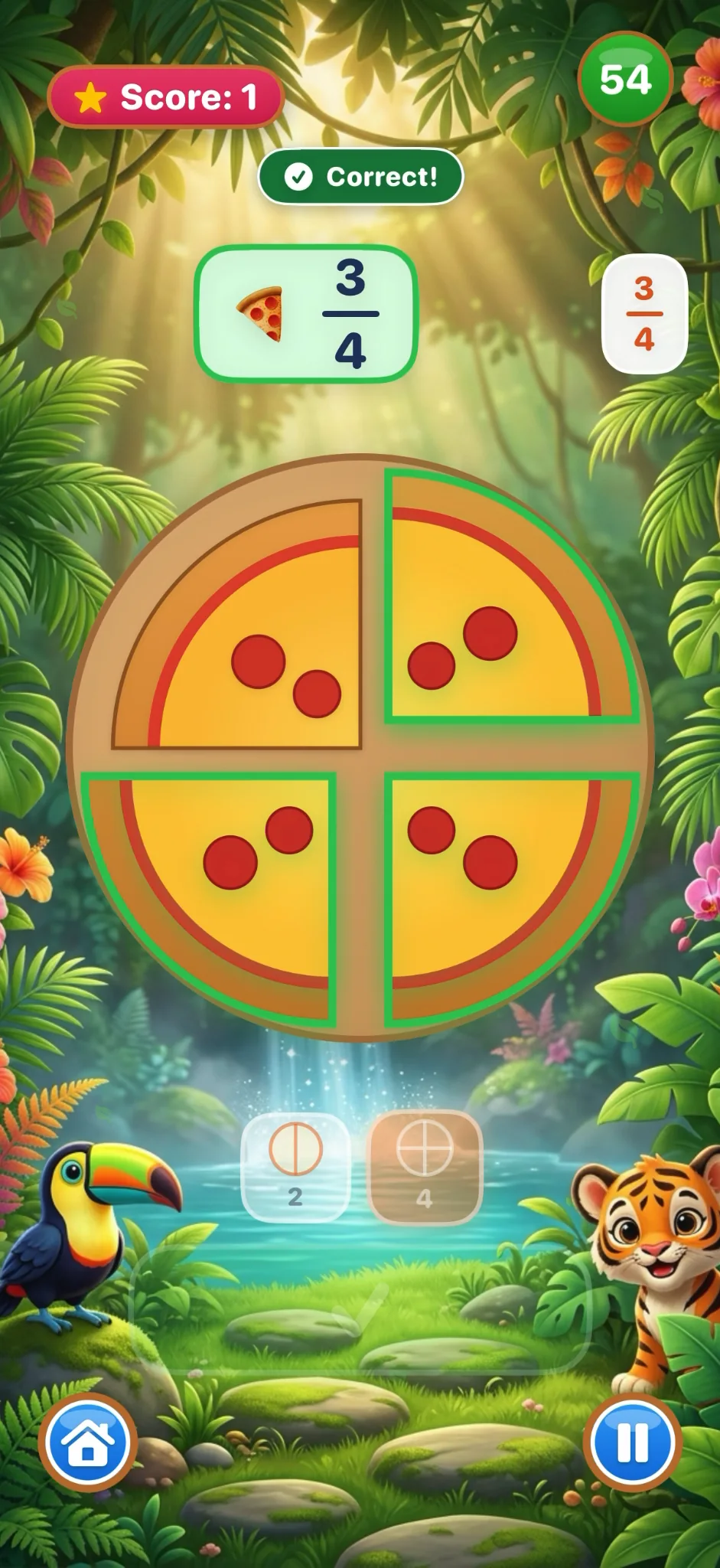
Prepare a circle divided into four equal quarters. Give two quarters to each of two toys. Put each pair into a half-circle and compare the shares. Move one quarter to the other toy and ask whether the sharing is still equal.
Ask together: “Did each guest get half? What changed when we moved a slice?”
3. The fair-share detective
Draw two identical rectangles. Divide one into four equal strips and the other into four visibly different widths. Ask which shows quarters and how your child knows. Count the pieces in both, then compare their sizes.
Ask together: “Both have four pieces. Does that mean both show quarters?”
4. Share a collection
Share eight equal-sized blocks between two toys, giving one at a time to each. Each receives four, so half of eight is four. Repeat with four toys: each receives two, so one quarter of eight is two. Keep all eight blocks visible throughout.
Ask together: “What was the whole collection? What does one equal share contain?”
A little adjustment: Begin with four blocks and two toys if eight is too much to track.
5. Build the same share in two ways
Prepare two identical paper strips. Divide one into two equal parts and the other into four equal parts. Colour one part of the first and two adjacent parts of the second. Line up the strips and compare the coloured lengths.
Ask together: “How can one coloured part and two coloured parts cover the same amount?”
Connect the words, pictures and numbers
When the child can describe the shares, introduce 1/2 and 1/4. The lower number tells how many equal parts make the whole; the upper number tells how many of those parts you mean. Keep a drawing beside each symbol.
| The whole | One half | One quarter |
|---|---|---|
| One circle | 1 of 2 equal pieces | 1 of 4 equal pieces |
| A collection of 8 blocks | 4 blocks | 2 blocks |
| A collection of 12 blocks | 6 blocks | 3 blocks |
Three mix-ups worth checking together
If your child calls a quarter “the small bit”, return to the whole and identify its four equal shares. A piece’s size on its own does not tell you its fraction.
- Different-sized wholes: half a big pizza can be larger than half a small one. Use identical wholes to compare the fraction shares.
- Unequal pieces: four pieces do not automatically make four quarters. Check that the parts are equal.
- Pieces and amount: two quarters and one half can describe the same amount, despite different piece counts.
Let the child create the next puzzle
Invite your child to draw one fair sharing example and one unfair example for you. They could choose whether two toys should share four or eight objects. Ask them to explain the picture before you answer.
Their explanation gives you a check of what the fraction words mean in context. Stay with halves, return to sharing without symbols or explore quarters again according to what your child shows you.
A little more to discover.
Pizza Fractions is in the Family Subscription. Potion Maths is a separate Bonus Arcade activity that also requires 90 earned Stars. Explore the game guide, then recreate a sharing example with paper shapes to discuss the whole and its parts.
Explore the game guideMade for iPhone & iPad, iOS/iPadOS 16+.
Free download with three core games to start. See current prices and subscription details in your local App Store.
Sources & further reading
These resources provide educational background and further activities. The worked examples and illustrations in this guide were created for the Kids Maths Games parent blog.
- Department for Education: Mathematics programmes of study
The primary mathematics programme for England; other countries have their own curricula.


