8 Easy Maths Games to Play at Home for Ages 4–8
Easy maths games at home can begin with things you already have: a few toy animals, paper or a clock. Pick one idea that fits what your child is exploring. Make the numbers smaller or bigger as needed, and let the conversation matter as much as the answer.

Choose a starting point, rather than an age test
Children of different ages can use the same objects for different questions. With five toy animals, one child might count each animal; another might find ways to split five into two groups. Begin where your child can take part comfortably.
| What they are exploring | A question to try |
|---|---|
| Counting objects | Can you give each toy one plate? |
| Parts of a number | Five toys altogether. Two are hiding. How many can you see? |
| Adding and subtracting | We have six. What if three more arrive? |
| Explaining a method | Can you show the same answer another way? |
Eight maths games you can set up today
1. The toy picnic
Set out four toys and a pile of paper plates. Ask your child to give each toy one plate, then check whether any toy has been missed. Add one more toy and discuss what needs to change. Make two picnic tables and compare how many toys sit at each.
Ask together: “How can we check that everybody has one?”
A little adjustment: Begin with two toys. Extend the round by asking what two more visitors would need.
2. The hidden part
Count five blocks together. Keep the whole group visible while you slide some behind a book. If three remain showing, ask how many are hidden. Reveal the blocks and check together. Swap roles so your child can choose the next hidden group for you.
Ask together: “Five altogether, three showing. What could be behind the book?”
A little adjustment: Show two visible groups before hiding anything. Increase the total only when that feels comfortable.
3. Make a matching dot card
Draw three dots on a card and put a blank card beside it. Ask your child to draw a matching quantity. Their dots can be in a line, triangle or different pattern. Compare the cards and discuss what changed and what stayed the same.
Ask together: “Do these have the same number, even though they look different?”
A little adjustment: Start with one or two dots. Later, ask about smaller groups inside a bigger pattern.
4. Finger-walk a number path
Write 0 to 10 in order on paper. Put a toy at 4 and move it three spaces forwards. Say the starting number before moving, and count one new landing place per step. The toy lands on 7, showing 4 + 3 = 7.
Ask together: “Where did we start, how many steps did we take, and where did we finish?”
A little adjustment: Use 0 to 5 first. Explore backwards journeys when your child is ready.
5. Share a paper pizza
Divide a paper circle into four equal quarters. Let your child give two quarters to each of two toys. Put each pair together and compare the shares. Discuss why two quarters of this pizza make the same amount as one half.
Ask together: “Did both toys receive the same amount of the whole pizza?”
A little adjustment: Begin with two equal halves. Prepared paper pieces keep the attention on sharing.
6. Become a clock detective
Choose a familiar whole hour, such as 4 o’clock. Show it on an analogue clock and find its short hour hand and long minute hand. Draw that time together, then look for the same arrangement on another clock. Explore one time before adding more.
Ask together: “Which hand tells the hour? Where is the minute hand at o’clock?”
A little adjustment: Introduce half past after whole hours are familiar. The hour hand moves between numbers.
7. Build a shape museum
Draw circle, triangle, square and rectangle labels. Find household objects with faces or outlines resembling those shapes. A cereal box has rectangular faces; the whole box is a three-dimensional object. Ask your child to explain why an object belongs beside a label.
Ask together: “What do you notice about the sides and corners?”
A little adjustment: Compare two shapes first. Later, discuss how a square is a special rectangle.
8. Open a pretend shop
Give two toys price labels of 2 and 3 play tokens. Ask your child to pay for one toy, then both together. Each same-sized token represents one unit. Swap customer and shopkeeper roles so your child can check your payment.
Ask together: “What would these cost altogether? Can you show the payment?”
A little adjustment: Stay within five initially. With real coins, explain that coin count and money value differ.
What to do when an answer goes wrong
Show the objects again and invite your child to move or point to them. Trace the number-path journey and check each landing place. For sharing, line up the pieces. A visible example gives you something concrete to discuss.
Offer a choice: another hidden-part puzzle or a shape hunt? There is no requirement to finish all eight games. One enjoyable round is a useful place to stop.
Connect a screen activity to the same idea on the table
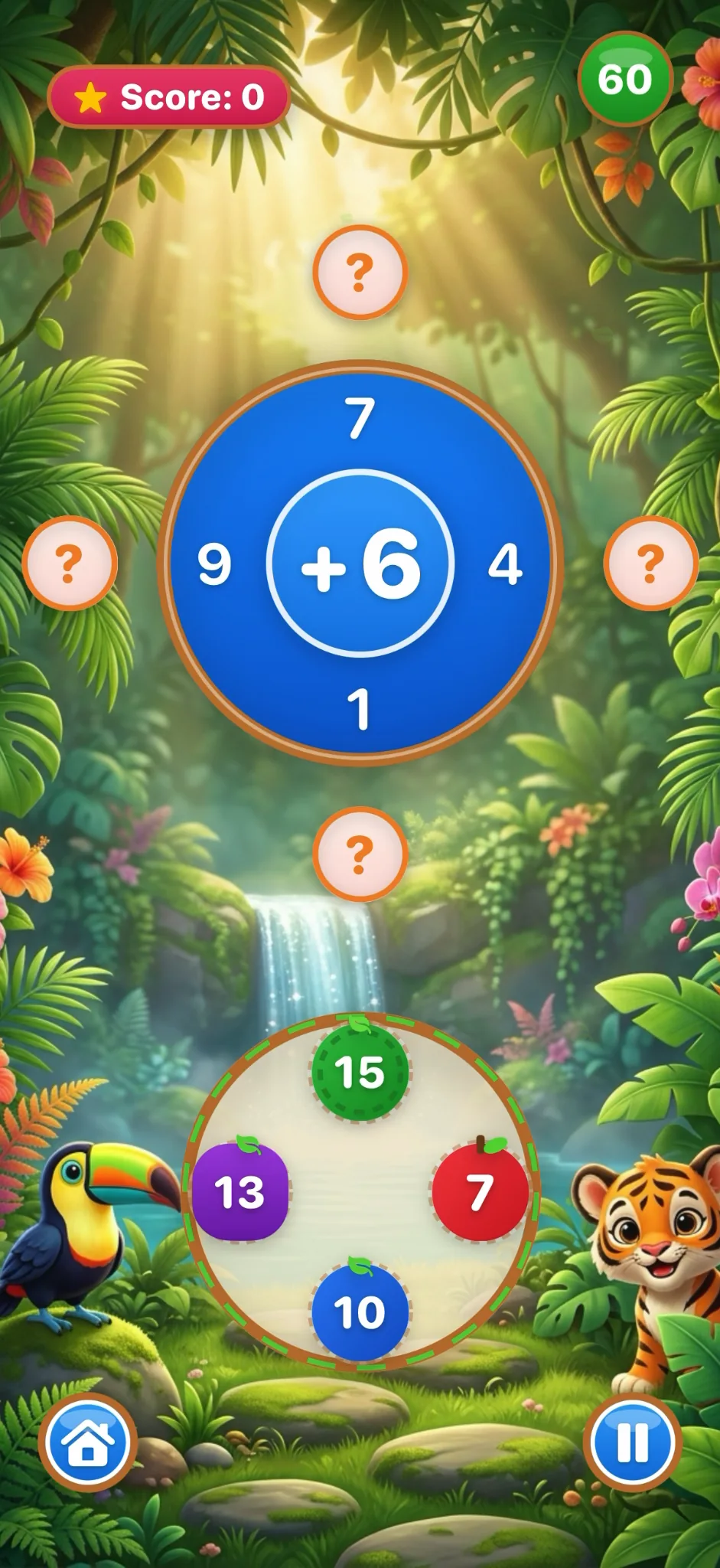
Before opening an app, name the idea you want to explore: matching quantities, finding a missing number or making a total. Afterwards, ask your child to recreate one example with paper or toys. You can talk about what happened on screen instead of only a score.
Our three-question number-bonds web taster is one place to begin. It has no timer. Afterwards, build a pair such as six and four using ten drawn circles.
A little more to discover.
The app is free to download, with Arithmetics, Maths Puzzle and Ladybird Matching Pairs available to start. An optional Family Subscription opens the paid library; Bonus Arcade games also require earned milestones. Keep an everyday object game alongside the screen activity if that helps explain the idea.
Explore the game guideMade for iPhone & iPad, iOS/iPadOS 16+.
Free download with three core games to start. See current prices and subscription details in your local App Store.
Sources & further reading
These resources provide educational background and further activities. The worked examples and illustrations in this guide were created for the Kids Maths Games parent blog.
- National Numeracy: Activities for ages 5 and under
Further ideas for noticing numbers in everyday family life.
- NRICH: Maths at Home — Number
A University of Cambridge collection for early number conversations at home.


