What Is Subitizing? Six Games for Early Number Sense
Subitizing means recognising how many things are in a small group without counting each one. You might recognise three dots on a dice face immediately. Children can explore the same idea with dots, fingers or familiar objects, starting with a quantity they can manage.

Seeing a quantity and counting are connected ideas
Recognising a group and counting its objects are different ways to answer “how many?” A child might recognise three dots immediately but count a larger group. That is a useful starting point for a conversation, not a reason to rush.
NCETM’s early-years guidance discusses familiar patterns such as dice faces and less regular arrangements of small quantities. The rounds below vary the pictures so the activity concerns quantity as well as remembering a pattern.
Pick a comfortable quantity
Draw two dots with enough space to see them clearly. Ask what your child notices, then try three. Let them point and count to check. If you show a picture briefly, show it again whenever they ask; you do not need to withhold it to make the task harder.
| What you notice | A next question |
|---|---|
| They recognise three in a familiar pattern | Can you make three look different? |
| They count every dot to check | Can you show the same amount with fingers? |
| They see two and another two | What do those groups make altogether? |
| They are guessing | Shall we use fewer dots and look together? |
Six subitizing games to try
1. Make my dot postcard
Draw three dots as a triangle. Let your child look, then ask them to make a matching quantity on another card. Compare the cards. For a new round, put the same three dots in a row so the child can notice the changed arrangement.
Ask together: “What stayed the same on our postcards?”
2. Match without matching the pattern
Make three cards with two dots in different positions and three with three dots in different positions. Lay them face up. Ask your child to find two with the same quantity and explain why they belong together even when the pictures differ.
Ask together: “How do you know these have the same number?”
3. Spot my small change
Show two dots, then a card with three. Ask what changed. Let your child make the next pair for you. Keep both cards visible at first, so the child can compare them without relying entirely on memory.
Ask together: “Is there one more, one fewer, or the same amount?”
4. Build a group inside a group
Draw four dots as two close pairs. Ask what smaller groups your child sees. Show four again as three close dots and one separate dot. Describe how both arrangements make four, then let the child invent another arrangement.
Ask together: “Did you see four at once, or smaller groups?”
5. Show it with fingers
Place a three-dot card on the table and invite your child to show the same quantity with fingers. Discuss whether a different finger arrangement works too. Then let your child show a quantity while you make its matching card.
Ask together: “Could you show that number another way?”
6. Check the pretend referee
Draw five dots close together and the same five spread further apart. Make a toy claim that the spread-out dots mean more. Invite your child to agree or disagree and show the toy how they checked the quantity.
Ask together: “Does spreading them out change how many there are?”
A little adjustment: Try three rather than five if that is a more comfortable starting point.
Listen for the explanation, not only the answer
“Two here and two there” tells you something different from “I counted one, two, three, four.” Either gives you a way into the next conversation. Invite your child to draw what they noticed or move objects to show it.
Keep questions simple: “How many?”, “What did you see?” and “How can we check?” Avoid comparing how quickly children answer. This is about noticing quantity and structure, not winning a race.
Use the idea away from dot cards
Notice groups already in your day, such as two shoes by the door or three toy cars in a row. Ask what your child sees before making it a formal question. Different objects can make an otherwise familiar amount interesting again.
With larger quantities, invite your child to describe smaller groups within them. Seeing six as three and three is different from instantly recognising a tiny group; every quantity need not be recognised in one glance.
A little more to discover.
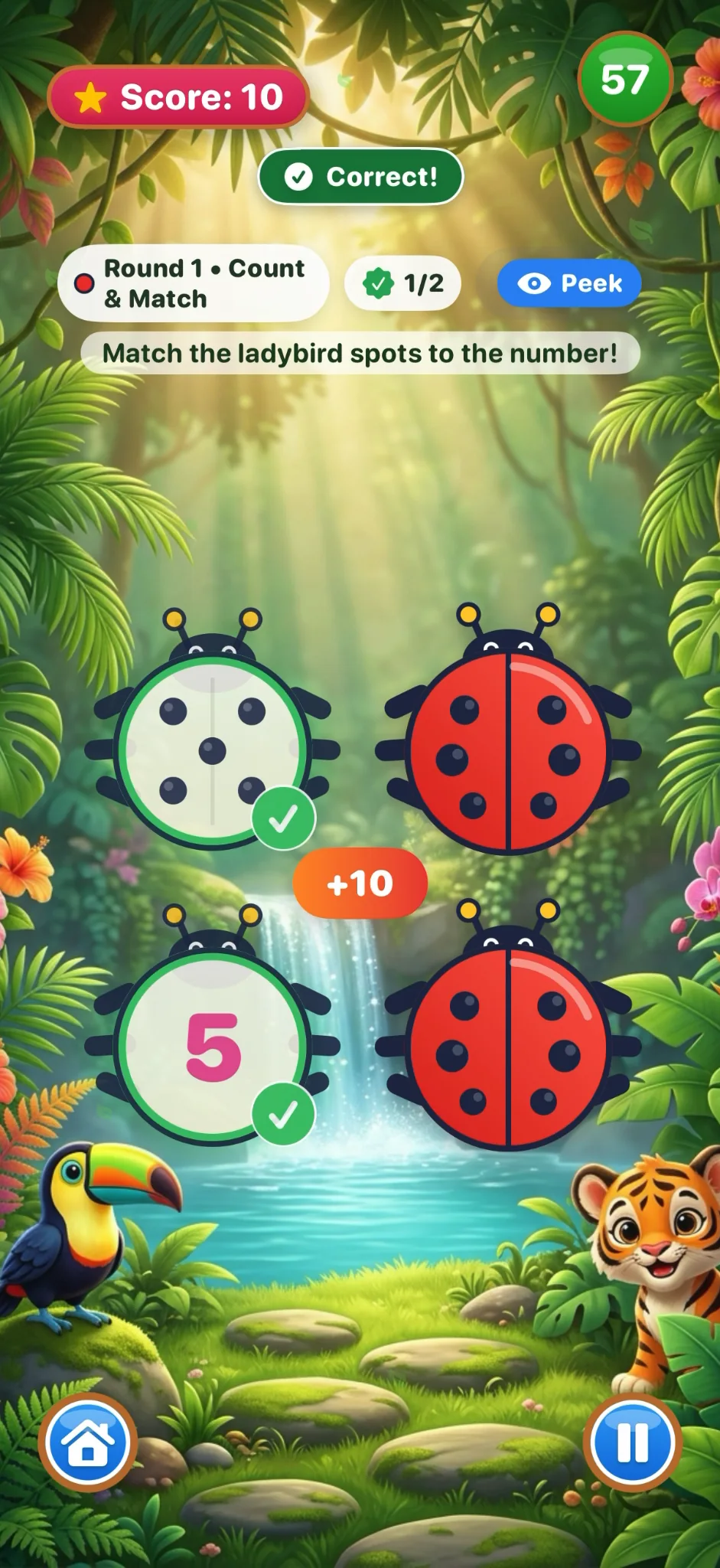
Ladybird Matching Pairs is one of the three free core games and explores spots, quantities and matching. Quick Look is part of the expanded subscription library. After a round, invite your child to draw a group they remember or describe smaller groups they noticed.
Explore the game guideMade for iPhone & iPad, iOS/iPadOS 16+.
Free download with three core games to start. See current prices and subscription details in your local App Store.
Sources & further reading
These resources provide educational background and further activities. The worked examples and illustrations in this guide were created for the Kids Maths Games parent blog.
- NCETM: Cardinality and Counting
Background on counting, recognising small groups and rearranging quantities.


