How to Teach Telling the Time on an Analogue Clock
To teach telling the time, name what each hand does, practise whole hours, then explore half past and quarters. Use an analogue clock alongside familiar routines. Keep the hour hand moving as minutes pass: at 3:30 it belongs halfway between 3 and 4.

What you need to begin
Choose a clock with clear numbers and hands that are easy to distinguish. A geared teaching clock helps because the hour hand moves as the minute hand turns. You can also draw faces, provided both hands are positioned correctly.
Use your child’s familiar school time words where possible. In England’s primary programme, whole-hour and half-past times appear before the later work on quarters and five-minute intervals. This is curriculum context, not a deadline for an individual child.
- Name the short hour hand and the long minute hand.
- Count around the hour numbers in their circular order.
- Talk about before, after and later in an ordinary day.
Start with o’clock
Set the minute hand at 12 and hour hand at 4. Say “four o’clock”, then invite your child to make another whole hour. Keep the minute hand in place while comparing 2:00, 5:00 and 8:00.
For a matching round, draw three whole-hour clock faces and write their digital times on separate cards. Ask your child to match one face with one time, then explain their choice.
Let the hands travel to half past
Begin at 3:00. Move the minute hand halfway around the face to 6. On a geared clock, notice the hour hand moving halfway towards 4. Say both versions: “half past three” and “three thirty”.
A half-hour is 30 minutes, half of the 60 minutes in an hour. Draw the clock before and after the journey and compare the two hour-hand positions.
| Time | Minute hand | Hour hand |
|---|---|---|
| 3:00 | At 12 | At 3 |
| 3:15 | At 3 | A quarter of the way from 3 to 4 |
| 3:30 | At 6 | Halfway from 3 to 4 |
| 3:45 | At 9 | Three quarters of the way from 3 to 4 |
Add quarter past and quarter to
When whole hours and half past are familiar, divide the clock’s journey into four equal sections. A quarter-hour is 15 minutes. At 3:15 the minute hand has reached 3: quarter past three. At 3:45 it reaches 9: quarter to four.
“Quarter to” names the hour coming next. Begin at 3:45 and move forward to 4:00. There are 15 minutes left until four, so both “three forty-five” and “quarter to four” describe the first clock.
Three short clock games for everyday practice
1. Build my clock
Choose one time within your child’s current stage. Describe it without a picture: “The minute hand points to 12. The hour hand points to 7.” Invite your child to draw or set the clock. Swap roles and follow their instructions next.
Ask together: “Which hand should I move first? What does it tell me?”
2. Find the hand that moved
Draw 2:00 and 2:30 side by side. Ask what changed. If your child spots only the minute hand, trace the shorter hand’s journey too. Try 5:00 and 5:30 next instead of introducing lots of new time words.
Ask together: “Did only one hand move, or did both?”
3. Make a routine card
Choose a real event happening at a convenient time, such as a regular club or planned story. Write its digital time and draw its analogue face. When the event arrives, compare the card with an actual clock. Keep the example truthful to your routine.
Ask together: “What do the hands look like when it is time for this?”
Two common mix-ups to talk through
If your child reads the minute-hand number as the minutes, count five-minute steps: 1 means five minutes, 2 means ten, and 3 means fifteen. Twelve of these steps make a full 60-minute turn. Introduce this layer once the earlier clock words feel comfortable.
If they put the hour hand exactly on 3 at 3:30, start at 3:00 and show it travelling towards 4. The hour hand does not wait at a number and then jump when the hour changes.
A little more to discover.
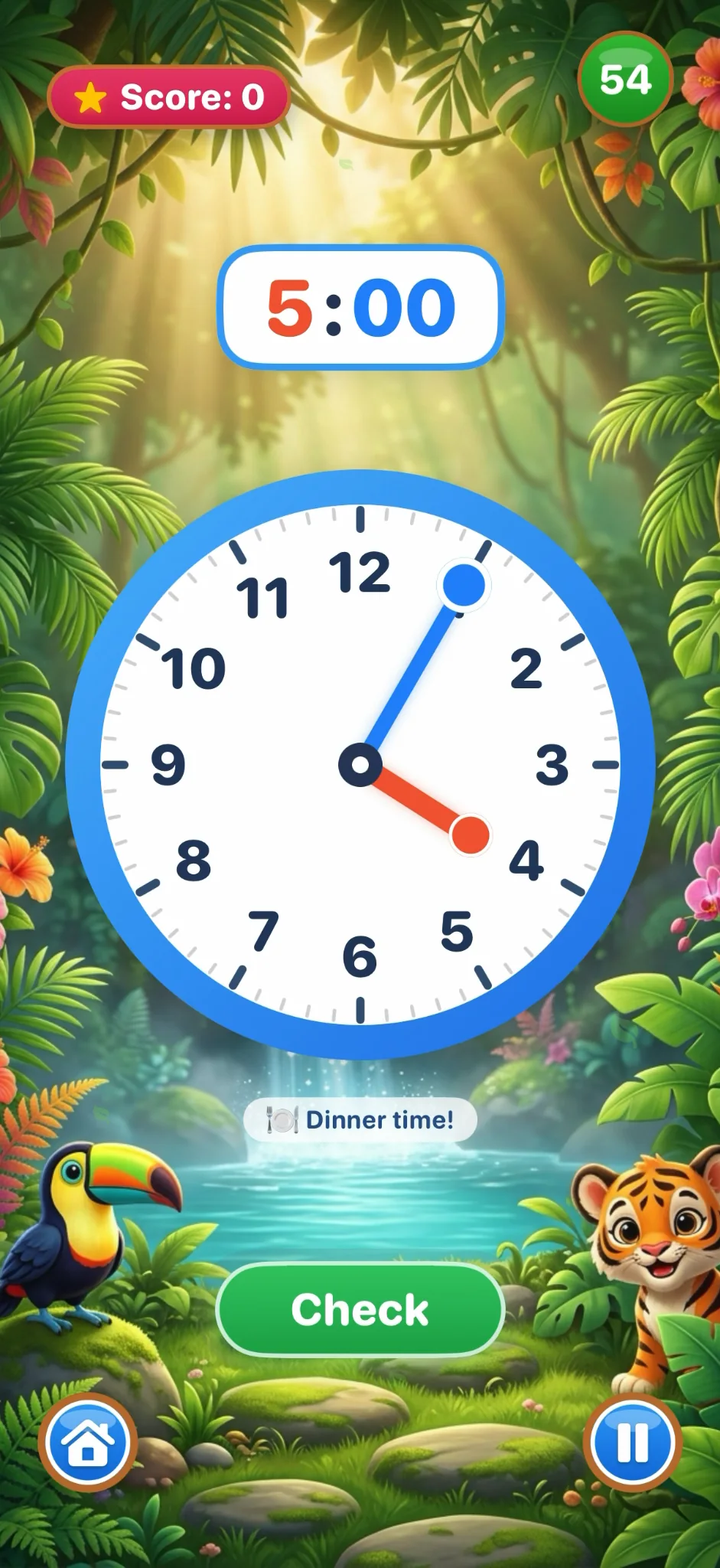
What’s the Time? is an analogue-clock activity in the Family Subscription, with hands children can drag. The game guide explains the activity and its access. Use a real or drawn clock alongside it to discuss both hands.
Explore the game guideMade for iPhone & iPad, iOS/iPadOS 16+.
Free download with three core games to start. See current prices and subscription details in your local App Store.
Sources & further reading
These resources provide educational background and further activities. The worked examples and illustrations in this guide were created for the Kids Maths Games parent blog.
- Department for Education: Mathematics programmes of study
The primary mathematics programme for England; other countries have their own curricula.


